How to Clean Saltillo Tile and Grout in Older San Antonio Homes
How to clean Saltillo tile: sweep first, damp mop with a pH neutral cleaner, rinse with clean water, dry the floor, and skip vinegar, bleach and steam.
Key Takeaways
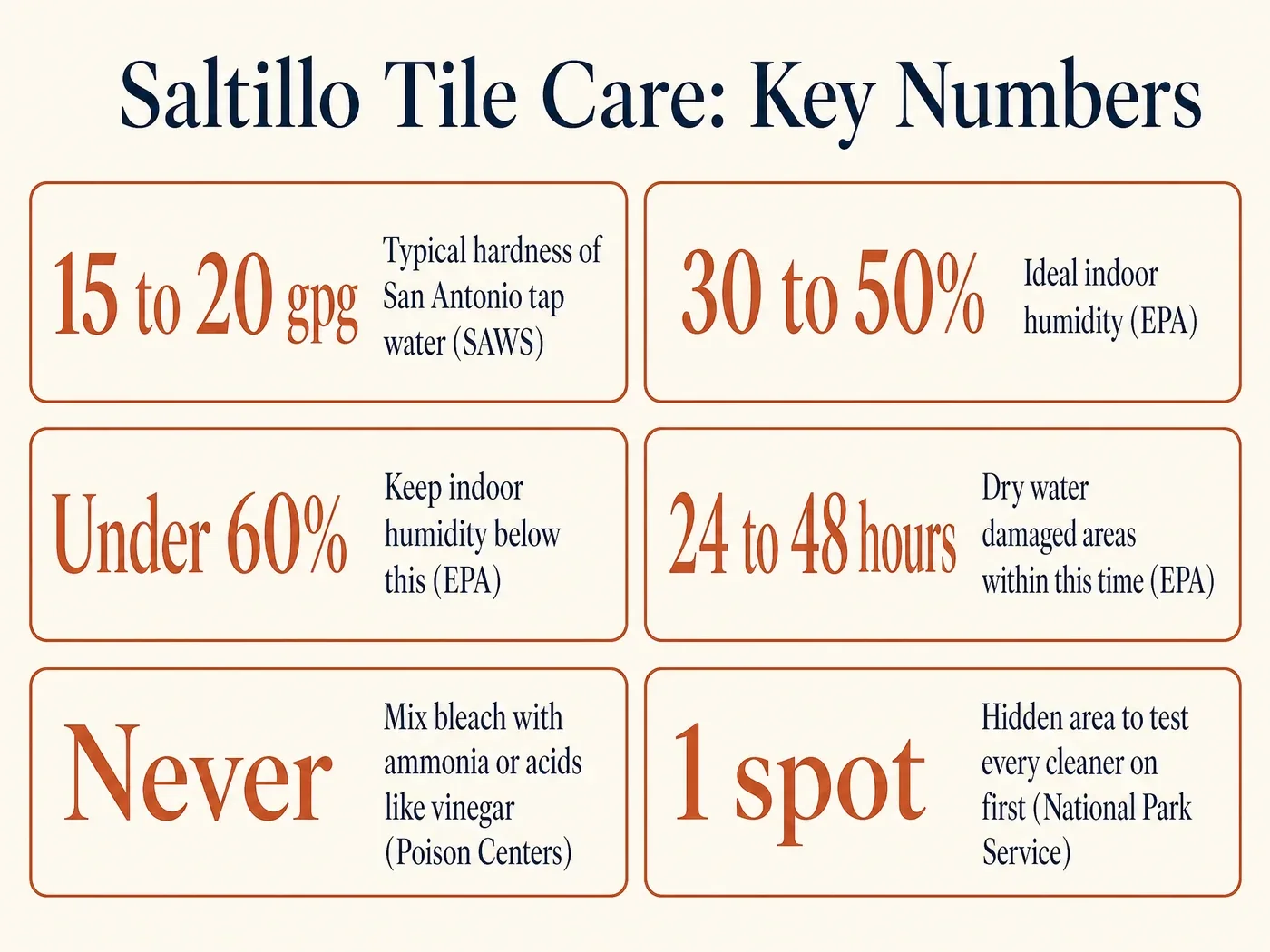
- The National Park Service guidance on historic tile floors says to start with the gentlest means possible, which may be just warm water, and to test every product on a hidden spot first.
- The Tile Council of North America (TCNA) says grout makers do not advocate acids because they attack the cement in grout, so vinegar is a poor choice for Saltillo tile grout.
- TCNA also says even good alkaline cleaners leave a sticky soap film if you do not rinse them off with clear water.
- San Antonio Water System (SAWS) reports typical hardness of 15 to 20 grains per gallon, so water left to dry on a floor can leave minerals behind.
- America's Poison Centers warns that bleach mixed with vinegar forms chlorine gas. If it happens, leave the area and call 1-800-222-1222.
- The EPA says to dry water damaged areas within 24 to 48 hours, and the National Park Service notes that porous tile can powder under constant moisture.
What makes Saltillo tile different from other tile?
Saltillo is a style of handmade terracotta clay tile that is usually left unglazed. The face is rough and uneven, and it soaks up liquid unless it is sealed. The name comes from the city of Saltillo, the capital of Coahuila state in northeastern Mexico, which Britannica describes as known for traditional crafts including pottery and ceramic tiles.
Porous clay works like a hard sponge. Water, grease and cleaner can sink into the tile instead of sitting on top. That is why cleaning Saltillo tile is different from cleaning glazed bathroom tile.
Older floors add another puzzle. If your older San Antonio home has Saltillo tile floors, they may have been waxed, coated or resealed more than once over the years. You may not know what is on yours. This is why you test first.
How do you tell if your Saltillo tile is sealed?
Do a water drop check. Pick a clean, dry spot in a hallway lane and place a few drops of water on the tile. If the drops bead up, you have a working sealer. If they soak in and darken the clay, the sealer is worn or missing.
What you do next depends on the result.
- Drops bead up: You have sealed Saltillo tile. Use the routine in this guide.
- Drops soak in and darken the clay: Treat the floor as unsealed. Dry sweep it and use only a barely damp mop until a flooring professional looks at it.
Follow the sealer maker's directions for any product that goes on the floor. TCNA says to follow the tile maker's sealer recommendations for unglazed tile. Stripping an old coating and sealing a floor is flooring restoration work. It is not part of a regular cleaning visit.
What do you need to clean Saltillo tile?
You do not need much, and most of it is already in your home. Gather these before you start:
- A soft broom or a microfiber dust mop
- A vacuum with the beater bar turned off
- A flat microfiber mop and a bucket you can wring out well
- A pH neutral tile and stone cleaner
- A soft nylon brush (never steel wool or a steel brush, which can scratch the clay)
- Clean, dry towels
- A second bucket for clear rinse water
Skip the beater bar. A spinning bar can scuff a rough clay face, so keep it off or use the hose attachment.
How do you clean Saltillo tile step by step?
Work in small sections and keep the mop barely damp, because clay and grout both hold on to water.
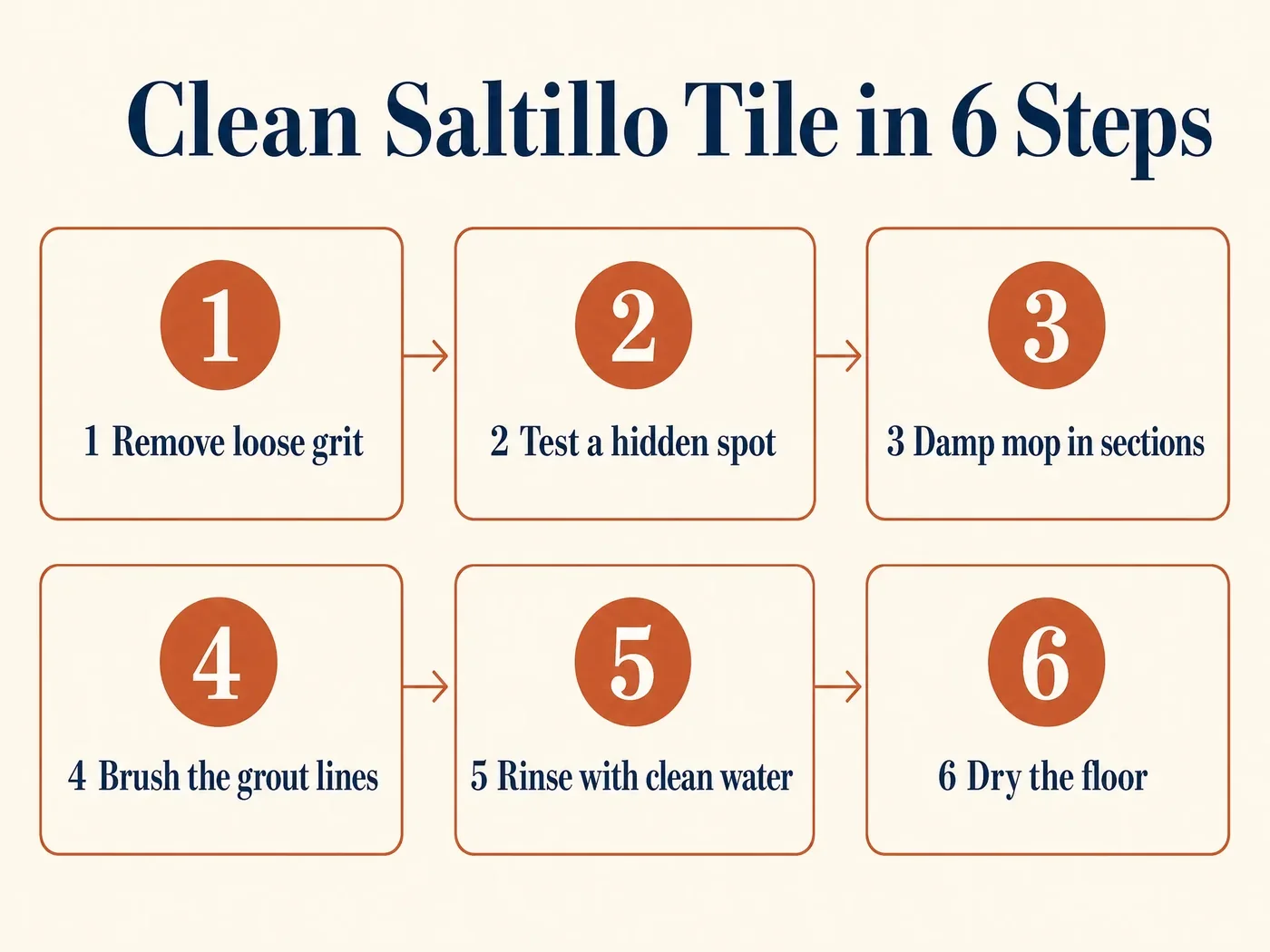
- Remove loose grit. Sweep with a soft broom or dust mop, then vacuum with the beater bar off. Grit acts like sandpaper under a mop, so do not skip this step.
- Test a hidden spot. The National Park Service advises starting with the gentlest means and testing every product in an inconspicuous area. Try your cleaner in a closet corner or under a doorway rug, then let it dry and look for dark spots or a changed finish.
- Damp mop in sections. Mix the pH neutral cleaner as the label directs and wring the mop until it barely drips. Mop a small section at a time. Do not let water pool in the grout lines.
- Brush the grout lines. While the grout is still wet, go over the lines with a soft nylon brush. Use light pressure and let the brush loosen the dirt.
- Rinse with clean water. Mop again with clear water from your second bucket, and change that water often. TCNA explains that even good alkaline cleaners leave a sticky soap film if they are not properly rinsed, and that film can attract dirt.
- Dry the floor. Wipe with a clean towel or a dry microfiber mop. Open the windows or run a fan, and do not leave puddles anywhere.
Drying matters more on Saltillo than on most floors. The National Park Service notes that porous, less hard fired tiles may powder or spall under constant moisture. A floor that stays wet for long stretches wears out faster.
How do you clean Saltillo tile grout?
Use a pH neutral cleaner and a soft nylon brush. TCNA says cement is dissolved by acids and that it is better to clean grout with an alkaline cleaner than an acid based one. A pH neutral cleaner keeps you clear of the acid risk.
Some people reach for vinegar on stubborn grout. TCNA says grout makers do not advocate acids because they attack the cement, and that regrouting is sometimes the result. Vinegar is an acid, so we agree with that caution.
Here is our practical call. For routine mopping, a pH neutral cleaner is the safest middle choice. It is not an acid that attacks cement grout, and it is unlikely to strip a finish from the tile. Brush the lines gently, rinse with clear water, then dry.
Do not scrub hard on crumbly grout. You will only pull out more of it. If the grout stays dark after a careful clean, it may need a professional deep clean or regrouting.
Which cleaners should you never use on Saltillo tile?
Skip anything acidic, oily or hot. The table below shows what works and what does not.
| Cleaner or product | Use on Saltillo? | Why |
|---|---|---|
| pH neutral tile and stone cleaner | Yes, for routine mopping | It is gentle on cement grout and on a sealer. This is what our team uses on sealed tile floors. |
| Warm water alone | Yes, for light dirt | The National Park Service says to begin with the gentlest means, which may be warm water. |
| Vinegar and other acids | No | The National Park Service says acid based cleaners should generally not be used on tile floors. TCNA says acids dissolve cement grout. |
| Oil soaps and pine cleaners | No | TCNA says to avoid oil and wax based cleaners on grout. |
| Bleach mixed with ammonia or vinegar | Never | The mix releases toxic gas. See the America's Poison Centers page on chlorine gas. |
| Steam mops | Skip | Our recommendation: hot water pushed into porous clay and grout is the opposite of a damp mop. |
The bleach rows deserve a closer look. America's Poison Centers says bleach mixed with ammonia forms chloramine gas. Bleach mixed with acids, such as vinegar and some toilet bowl cleaners, forms chlorine gas, which causes burning of the eyes, nose and throat, and a cough.
If this happens, leave the area right away and get fresh air. Then call the Poison Help line at 1-800-222-1222. Never mix bleach with ammonia or acids, and wear gloves and ventilate whenever you use any cleaner.
Why does San Antonio water leave a white film on Saltillo tile?
Hard water is one common cause. SAWS says hardness is the concentration of calcium and magnesium in the water, and typical hardness in SAWS water is 15 to 20 grains per gallon. SAWS also says hard water is not a health hazard.
When water dries on a floor, the minerals stay behind as a dull haze. A clean rinse and a dry floor keep that haze from building up. If you also fight spots on shower glass and faucets, our guide on how to remove hard water stains in San Antonio homes covers those surfaces.
Not every white haze comes from your tap. TCNA describes efflorescence as water soluble minerals that move up to the grout surface as water evaporates. Those minerals come from the cement slab below the tile or from the ground below the slab.
TCNA says that saturating grout joints during periodic cleaning generally does not cause efflorescence. Detergent residue mixed with soil can also build up as a sticky, light colored film on grout. TCNA says a tile floor can often be cleaned with extremely small amounts of cleaner and enough rinse water to remove all traces of dirt and cleaner.
Here is a simple rule. If the haze comes back after a good rinse and a dry floor, stop scrubbing. The cause is probably moisture from below, and more scrubbing will not fix it.
The EPA says to keep indoor humidity below 60 percent, ideally between 30 and 50 percent, and to dry water damaged areas within 24 to 48 hours. Both help a clay floor. For more on not over wetting your floors, read our post on cleaning with less water.
How do you keep Saltillo tile clean between mopping?
Sweep or dust mop often. Grit scratches clay, and the National Park Service advises against abrasive cleaners and mechanical equipment on tile floors. A quick pass with a microfiber dust mop does more for your floor than an extra mopping.
- Put mats at the doors to catch grit and moisture.
- Wipe spills right away, because porous clay soaks them up.
- Take shoes off at the door if you can.
Our regular House Cleaning visits include vacuuming and mopping hard floors. Recurring Cleaning keeps that routine going so grit and film never build up.
When should you call a professional for Saltillo tile?
Call a flooring restoration professional when the problem sits in the tile or its coating, not in the dirt on top. Cleaning will not fix these:
- Old wax or coating buildup
- A floor that is unsealed or blotchy
- Tile that is powdering or flaking, which the National Park Service links to constant moisture in porous tile
- Loose or hollow sounding tile
- Grout that is crumbling
We want to be clear about what our team does. We clean floors as part of House Cleaning and use a pH neutral cleaner on sealed tile. During Deep House Cleaning, we scrub bathroom tile and grout in detail.
We do not strip, seal or regrout floors. We also do not handle mold remediation. The EPA says you can scrub mold off hard surfaces with detergent and water and dry completely, but that applies to small hard surface spots only. Larger mold is outside what we do.
If the home is being cleaned before a move, Move-In/Move-Out Cleaning covers the floors along with the rest of the house. If you are planning a bigger reset, our room by room guide for spring cleaning can help you plan it.
Saltillo Tile Cleaning FAQs
Can you use vinegar to clean Saltillo tile?
No, we recommend against it. The National Park Service says acid based cleaners should generally not be used on tile floors. TCNA says grout makers do not advocate acids because they attack the cement, and regrouting is sometimes the result.
Can you use a steam mop on Saltillo tile?
We recommend skipping it. Saltillo is porous clay, and steam pushes hot water into the tile and the grout lines. A well wrung, barely damp microfiber mop is a better fit for these floors.
Is bleach safe to use on Saltillo tile?
We do not recommend it for routine cleaning. A pH neutral cleaner does the job without the risks. Never mix bleach with ammonia or with acids such as vinegar, because the mix forms toxic gas.
How do you clean unsealed Saltillo tile?
Keep it dry. Dry sweep it and use only a barely damp mop. Then have a flooring professional look at the floor, because unsealed clay soaks up liquid and stains easily.
How often should you seal Saltillo tile?
Follow the sealer maker's directions, and use the water drop check to see where you stand. If drops bead on the tile, the sealer is still working. If they soak in and darken the clay, it is time to talk with a flooring professional.
Does San Antonio hard water hurt Saltillo tile?
It can leave a dull mineral haze. SAWS reports typical hardness of 15 to 20 grains per gallon, and the minerals stay behind when water dries on the floor. A clear water rinse and a dry floor keep the haze from building up.
Does San Antonio Maid Services clean Saltillo tile floors?
Yes. Hard floors are part of House Cleaning, and our team uses a pH neutral cleaner on sealed tile. We do not strip, seal or regrout floors, and you can read more on our FAQ page. If anything is not right, tell us within 24 hours and we will make it right at no additional charge, as described in our service standard.
Want your floors cleaned by people who know the rules?
Our team is background checked, carefully selected and vetted by us. We give you a 30 minute arrival window, so you are not waiting around all day.
See your price in under a minute. Booking is available 24/7.
Get Your Instant Quote or Book Online Now. You can also call (210) 405-7040.
Our service areas include San Antonio, Alamo Heights, Terrell Hills, Olmos Park, Shavano Park, Stone Oak, The Dominion, Rogers Ranch, and Hill Country Village.